







Licensed NSW Plumber 306733C
Professional, licensed help for rainwater tank systems that are sized properly, plumbed correctly, and easy to maintain.
If you’re looking for a rainwater tank in Sydney, the right setup depends on what you want to run (garden, toilets, laundry), your roof capture area, available space, and how the pump/top-up is connected. A well-designed system includes safe separation from drinking water, correct backflow protection where required, reliable pump selection, and access points for cleaning and maintenance. Apex Plumbing Services supplies, installs, plumbs, cleans, maintains and repairs rainwater tank systems across Sydney.
Licensed plumber: 306733C
24-hour emergency services available
Fixed pricing style
24-hour support available if required (provided)
122+ 5-star reviews
20,000+ projects completed
See real work examples: View Recent Tank and Plumbing Projects
Not For You If
Request a Fixed Quote or call 1300 096 668.

Read what customers say in 123 Google reviews.
A house water tank setup works best when the tank size and plumbing match your real demand. Bigger isn’t always better if it’s hard to maintain or you don’t have enough roof capture to keep it turning over. Too small can mean constant top-ups and pump cycling. The goal is a system that’s easy to live with: stable pressure, cleanable access points, and simple isolation so maintenance doesn’t become a headache.
Most Sydney homes get better outcomes when sizing starts with use cases (garden only vs garden + laundry/toilets), then checks roof catchment, then confirms space and overflow discharge. This approach avoids overspending on capacity that never fills or, conversely, under-sizing and relying on frequent mains top-ups.
| Situation | Best Fit | Why | Next Step |
|---|---|---|---|
| Garden watering only | Above-ground tank + pump to taps | Simple plumbing, easy access | Size the tank + confirm tap locations |
| Laundry/toilets planned | Tank + pump + internal non-drinking linework | Higher savings, more plumbing detail | Confirm fixture eligibility + safety separation |
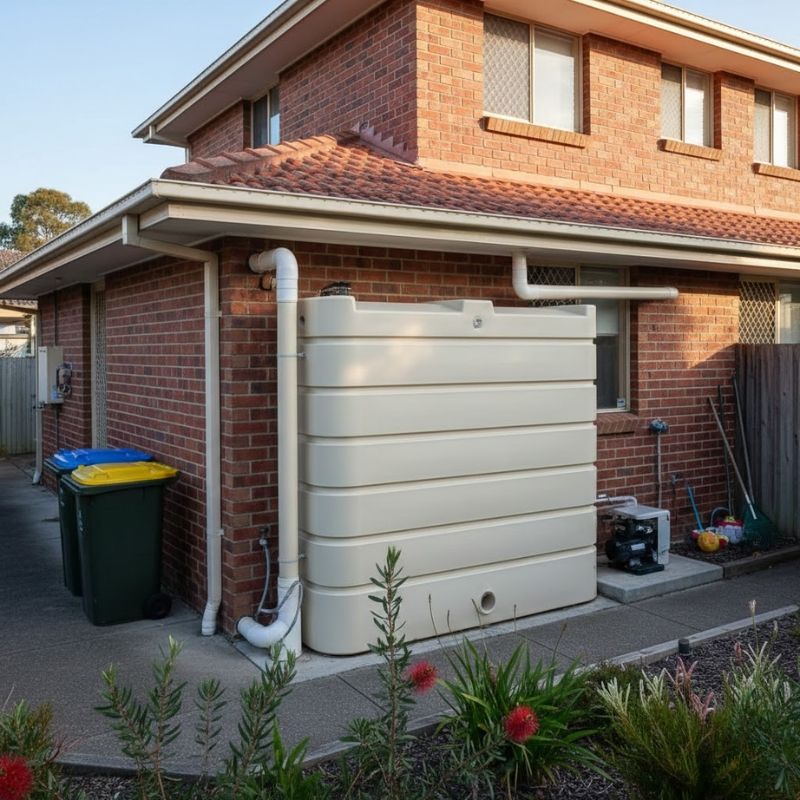
| Limited side access | Slimline tank + compact pump set | Fits tight spaces | Measure access + pick tank footprint |
| Pressure issues today | Correct pump + controller/accumulator | Stops surging and short cycling | Check demand points + head height |
When comparing materials and long-term durability, consult this guide before committing to a tank type: Rainwater Tank Materials Guide.
A “good” rainwater tank job isn’t just the tank — it’s how the whole system behaves day-to-day. The right install matches tank size to roof area and rainfall patterns, places the tank on a stable base, sets up overflow so it won’t undermine foundations, and ensures the pump delivers usable pressure without constant cycling. Just as important: the plumbing connection must keep rainwater and mains water safely separated, with a top-up method that doesn’t create cross-connection risk.
Depending on your property and goals, your scope may include tank supply, pump selection, inlet screening/first-flush options, line runs to garden taps or internal fixtures (non-drinking), overflow management, isolation valves, and commissioning checks. If anything falls outside plumbing scope (for example, structural works or access changes), it’s listed clearly so your quote stays predictable.
A tank system is typically worth doing when you have:
We service Sydney, NSW, including Fairfield, Canada Bay, Blacktown, Sydney, Georges River, Inner West, Bayside, Willoughby, Canterbury-Bankstown, Cumberland, The Hills Shire, Strathfield, Woollahra, Waverley, Burwood, Parramatta, Randwick, Ryde, Hunters Hill, Lane Cove and Mosman.
We’re proud to be highly rated for fast response times, expert solutions, and friendly service. Read real reviews from satisfied plumbing customers.
Rainwater tank plumbing is where most long-term issues start — and where a proper job shows up. A compliant system is designed so rainwater lines are clearly identified, outlets are appropriate for non-drinking water use, and any mains top-up is configured to prevent cross-connection. The plumbing also needs to allow for cleaning access and maintenance without requiring the dismantling of the entire setup.
Low pressure at taps (pump sizing, friction loss, controller issues)
Surging flow (controller behaviour, no accumulator, air ingress)
Mains top-up that runs too often (float level, leaks, incorrect configuration)
Overflow that causes pooling (poor discharge point or grading)
Pump losing prime (suction-side air leaks, blocked inlet screens)
Tip 1: If a tank feeds multiple points, design around your highest demand moment (garden + toilet refilling + laundry), not the average day. That’s where pump selection and line sizing matter.
Tip 2: Many “pump failures” are suction leaks or blocked inlet screens. Fixing the cause first often restores performance without unnecessary replacement.
To verify trade licensing in NSW: Check a Builder or Tradesperson Licence.
Clarify whether the tank water will be used for garden only or connected to internal fixtures, then confirm the exact outlets you want supplied.
Check roof catchment condition, gutters, downpipes, access, the proposed base location, and where overflow can safely discharge.
Map the system layout including filtration, outlets, isolation valves, labelling, and enough clearance so servicing is straightforward.
If a mains top-up is needed, confirm the approach and ensure safe separation/backflow prevention so drinking water supply stays protected.
Run pressure and flow checks, test operation at supply points, and complete full leak checks across all connections.
Provide a simple maintenance checklist (cleaning, filter checks if fitted, and periodic inspections) so performance stays stable.
Cleaning isn’t just “drain and rinse”. A proper cleaning focuses on the cause of sediment, sludge and odour — and whether the tank is turning over often enough. The goal is to restore usable water quality for the intended purpose (usually non-drinking uses), keep the pump protected, and set up screens/filters so the problem doesn’t return quickly.
If smells or sediment keep returning, we’ll typically recommend the smallest change that actually fixes the source (screening upgrades, first-flush servicing, gutter/debris control, or suction-side sealing) rather than repeating cleans on a system that’s being re-contaminated.
Rainwater tank maintenance is what keeps the system predictable — especially in Sydney where storms can dump debris quickly and long dry spells can concentrate sediment. A simple, repeatable checklist reduces smells, improves pump life, and prevents overflow issues from becoming property issues.
Before you book a repair, these checks often identify the cause:
If you need broader plumbing support beyond tanks, here’s the full service list: Explore All Plumbing Services.
Repairs should be guided by diagnosis, not guesswork. A “tank problem” might be a pump/controller fault, a suction leak, blocked inlet filtration, a cracked fitting, or an overflow issue causing flooding near the base. The fastest fix is the one that identifies the failure point and corrects the underlying condition so it doesn’t keep returning.
If the system is older, it’s often more cost-effective to repair selectively (controller, seals, suction integrity) while upgrading weak points (screens, valves, labelling). If the tank itself is compromised, we’ll spell out replacement options clearly and keep the quote fixed and practical.
Most pump issues show up as low pressure, pulsing flow, noisy operation, or a pump that runs but delivers little water. The right repair approach checks suction integrity first, then controller behaviour, then pump condition. Replacing a pump without checking suction leaks or blocked strainers can lead to the same symptoms returning.
A couple of official references are useful when you’re planning a tank system and deciding where rainwater should (and shouldn’t) be used.
For general rainwater tank guidance: Sydney Water Rainwater Tanks.
For NSW licensing verification: Check a Builder or Tradesperson Licence.
If you’d like a deeper reading from our knowledge base:
A rainwater tank system is only as reliable as the design and the plumbing connection. Apex Plumbing Services focuses on practical system outcomes: stable pressure, safe separation from drinking supply, cleanable layouts, and clear “what’s included” scopes so you don’t end up paying twice for fixes that should have been designed out from day one.
See verified customer feedback here: Read Customer Reviews.
If you want a rainwater tank system that’s sized properly and plumbed for long-term reliability, send your details, and we’ll confirm the best setup for your home and the fastest booking window.
Book a Fixed Quote
Apex Plumbing Services